Tell us about the job
Takes about a minute. No obligation.
A boiler repair in Harris County starts with what the system has been asked to carry and for how long. 71 severe weather events were recorded in Harris County, Georgia between 2015 and 2024. At that rate, severe weather is an occasional event here, not a condition the system fights through every season. A contractor opening a boiler in this county will look hard at the heat exchanger, the controls, and the flue before the weather record enters the conversation, because the load from local storms alone does not explain most of what fails. Deferred maintenance and the original installation are where the answers sit.
Boilers that have been heating a house since it was built accumulate wear in ways that do not show on the outside: corroded heat exchangers, failing seals, sediment in the sections. Half the homes in Harris County, Georgia were built in 1997 or earlier (2020-2024 ACS 5-year). A contractor opening a boiler in stock like this expects to find conditions specific to that unit's actual history, not a generic fault pattern. What they find determines whether the repair is a single component or a sequence of them.
The Parts of a Boiler a Contractor Checks First
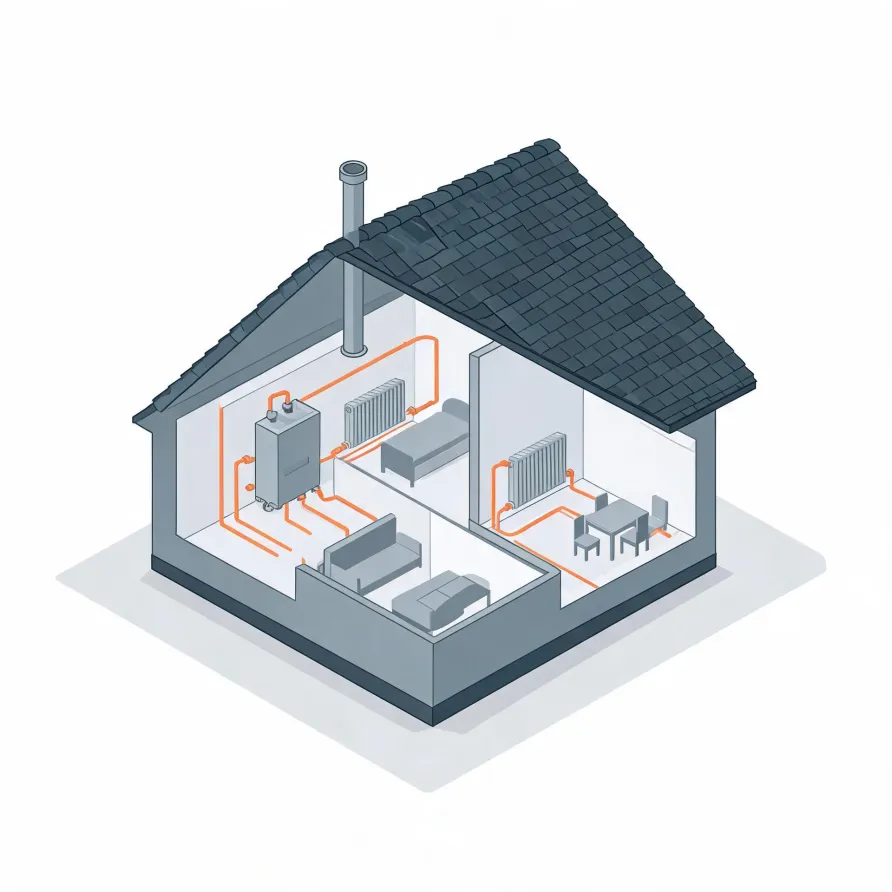
The boiler itself sits in the basement or a utility room and is the piece a contractor reaches first. It heats water and pushes it out through the system. When a boiler runs short, cycles oddly, or stops producing heat altogether, the burner assembly, heat exchanger, and pressure relief valve inside that unit are where the diagnosis starts.
From the boiler, hot water travels through supply pipes to radiators or baseboard units in each room, then returns through a second set of pipes. The circulator pump, mounted on those pipes near the boiler, keeps water moving. A failed pump, a stuck zone valve, or a waterlogged expansion tank can each kill heat to part or all of the house without the boiler itself being the source of the problem.
The drawing shows a typical boiler layout, and a licensed contractor determines which parts and connections apply to your specific system.
Get matched in Harris CountyHarris County, Georgia, by the numbers
71 severe weather events were recorded in Harris County, Georgia between 2015 and 2024.
NOAA National Centers for Environmental Information, Storm Events Database, bulk CSV export, events 2015-01-01 through 2024-12-31.Half the homes in Harris County, Georgia were built in 1997 or earlier (2020-2024 ACS 5-year).
U.S. Census Bureau, 2020-2024 American Community Survey 5-Year EstimatesHarris County, Georgia holds 14,699 housing units (2020-2024 ACS 5-year).
U.S. Census Bureau, 2020-2024 American Community Survey 5-Year EstimatesOwners occupy 88.8% of the occupied homes in Harris County, Georgia (2020-2024 ACS 5-year).
U.S. Census Bureau, 2020-2024 American Community Survey 5-Year EstimatesSevere Weather Events in Harris County
Weather puts direct stress on heating equipment: hard cycles, sudden load shifts, and extended run times all add up. Boiler repair needs in Harris County track closely with what the local climate demands from the system.
71 severe weather events, 2015–2024. Source: NOAA National Centers for Environmental Information, Storm Events Database.