Tell us about the job
Takes about a minute. No obligation.
A boiler repair in Columbia County starts with the system itself: how old it is, whether it has been serviced, and which components show the kind of slow deterioration that builds quietly over seasons of regular use. 121 severe weather events were recorded in Columbia County, Georgia between 2015 and 2024. At that rate, severe weather is part of the operating environment here, but a contractor diagnosing a failed heat exchanger or a failing pump is unlikely to find weather the primary culprit. What the record tells a contractor is to check seals and connections that stress events can work loose over time, not to expect catastrophic weather damage as the opening finding. Age and service history are what drive most of the scope.
Half the homes in Columbia County, Georgia were built in 1999 or earlier (2020-2024 ACS 5-year). Housing built around that era was typically retrofitted as systems were replaced over the years, so the ductwork, electrical, and structural constraints that can dominate repair scopes in genuinely aged stock are less likely to be what a contractor finds driving the problem here. What decides the job is what comes apart once the boiler is opened: the condition of the heat exchanger, the burner assembly, and whether the parts the unit takes are still in production. A boiler serving a house in this county is probably running in an environment that was adapted for it, which means the repair conversation starts and ends with the equipment.
The Parts of a Boiler a Contractor Checks First
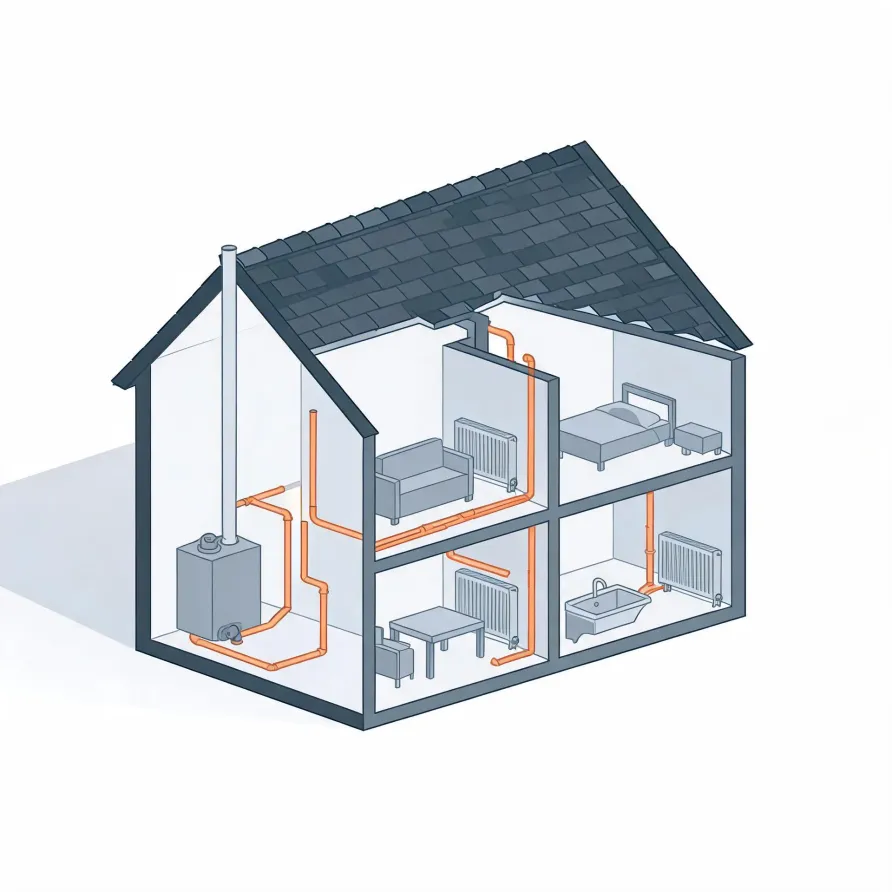
The boiler itself sits in a mechanical room, basement, or utility closet and is the unit that heats the water the rest of the system depends on. When heat stops reaching the rooms, a contractor starts here, checking the burner, the heat exchanger, and the controls that tell the unit when to fire.
From the boiler, pipes carry hot water to radiators or baseboard units in each room, then return the cooled water back. The circulator pump moves water through that loop, and the expansion tank nearby absorbs pressure changes as the water heats and cools. A failed circulator or a waterlogged expansion tank shows up as uneven heat or no heat at all.
The drawing shows a typical boiler layout, and a licensed contractor determines which components apply to your specific system.
Get matched in Columbia CountyColumbia County, Georgia, by the numbers
121 severe weather events were recorded in Columbia County, Georgia between 2015 and 2024.
NOAA National Centers for Environmental Information, Storm Events Database, bulk CSV export, events 2015-01-01 through 2024-12-31.Half the homes in Columbia County, Georgia were built in 1999 or earlier (2020-2024 ACS 5-year).
U.S. Census Bureau, 2020-2024 American Community Survey 5-Year EstimatesColumbia County, Georgia holds 61,668 housing units (2020-2024 ACS 5-year).
U.S. Census Bureau, 2020-2024 American Community Survey 5-Year EstimatesOwners occupy 78.1% of the occupied homes in Columbia County, Georgia (2020-2024 ACS 5-year).
U.S. Census Bureau, 2020-2024 American Community Survey 5-Year EstimatesSevere Weather Events in Columbia County
Boilers work hardest when outside conditions are at their worst, and Columbia County's weather shapes how much stress local equipment takes year to year. That load is a local fact, and it bears directly on what repair work looks like here.
121 severe weather events, 2015–2024. Source: NOAA National Centers for Environmental Information, Storm Events Database.